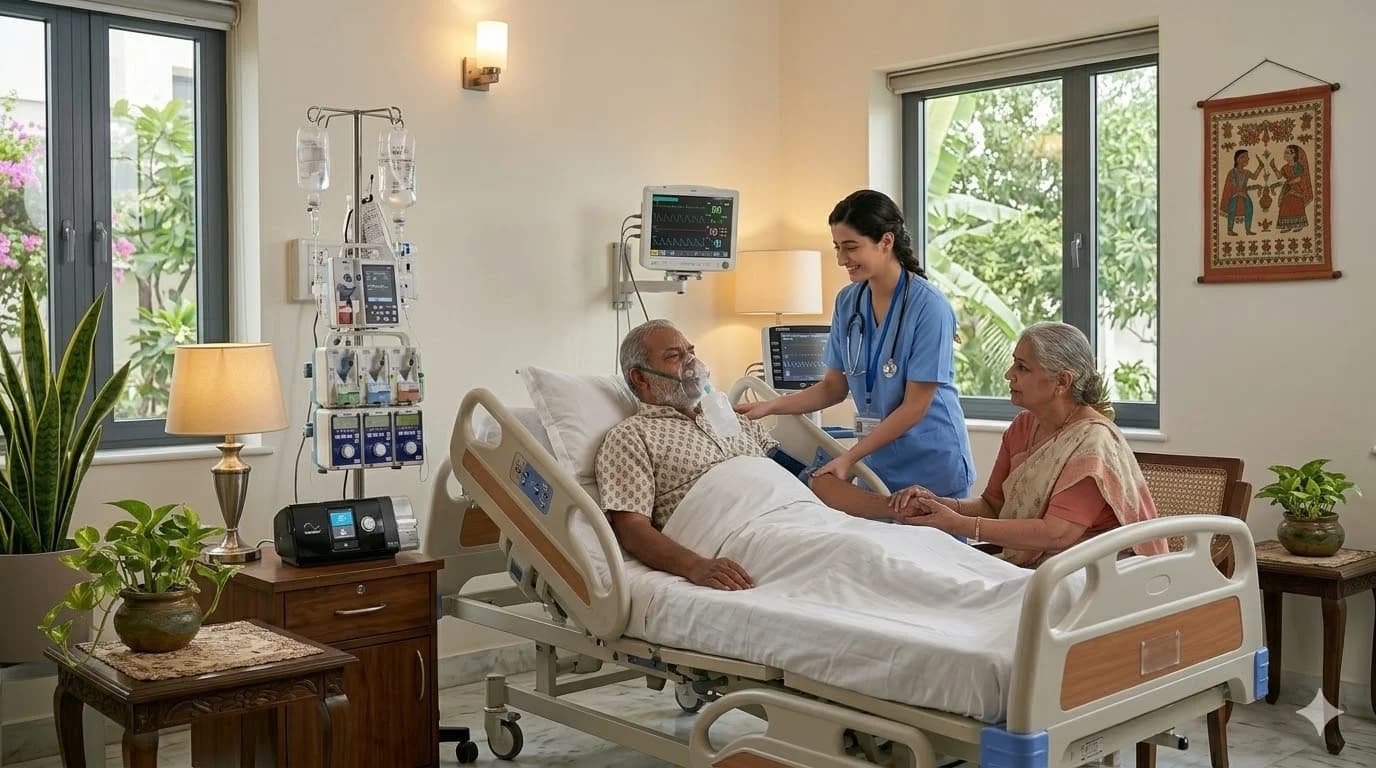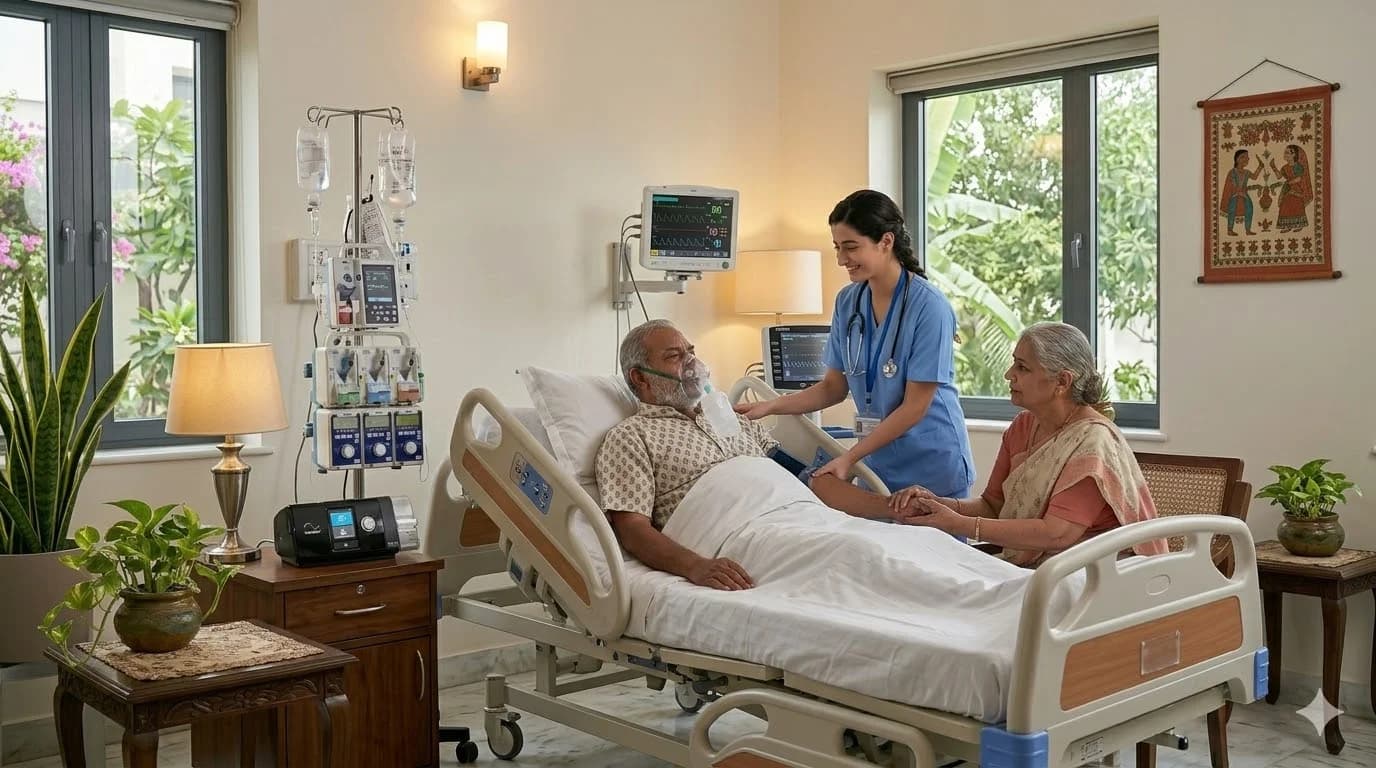
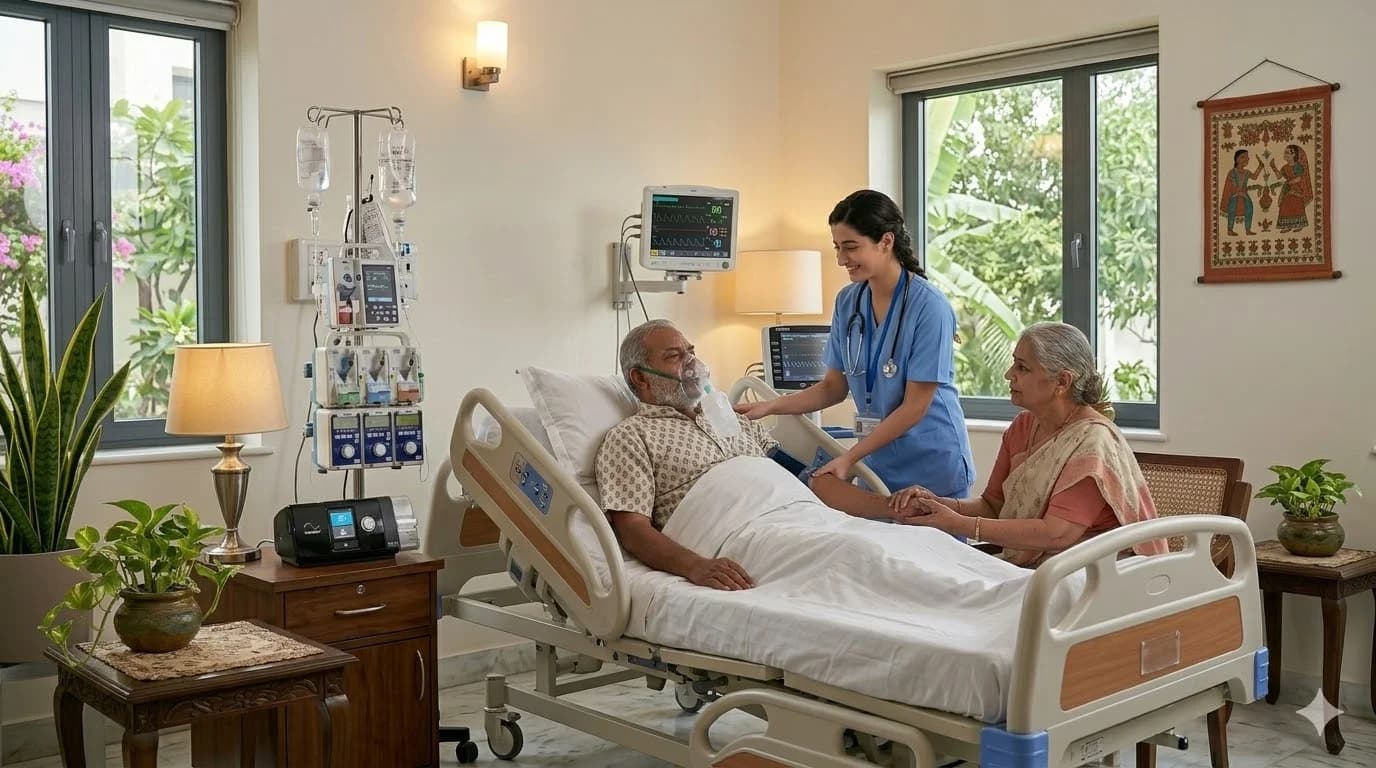
When a family member is discharged from an intensive care unit but still requires skilled nursing around the clock, the question of where that care happens — and whether it can safely happen at home — becomes one of the most consequential decisions a family will face. Critical care nursing at home is a genuine and growing option in India, but it is not the right choice for every patient or every household. Understanding what it actually involves, who it suits, and what it demands is essential before making any decision.
This guide is specifically about the nursing care component of high-dependency home care — the qualifications, the shift structures, the clinical tasks, and the candidacy criteria. It complements rather than duplicates other resources on this topic; if you are still in the process of deciding whether home care or hospital continuation is appropriate, you may also find it useful to read about choosing a home nurse as a starting point for understanding the broader landscape of home nursing.
What Critical Care Nursing at Home Actually Involves
Critical care nursing at home is not the same as standard post-operative nursing or general home care. It refers to the provision of skilled nursing for patients who remain medically complex after discharge — typically those who have spent time in an ICU or high-dependency unit and continue to need:
- Ventilator management — monitoring settings, responding to alarms, suctioning circuits, and coordinating with the respiratory team if parameters drift
- Tracheostomy care — regular cleaning and inspection of the stoma site, inner cannula changes, and emergency tube management
- Continuous physiological monitoring — SpO₂, heart rate, respiratory rate, blood pressure; recognising trends that suggest deterioration before a crisis develops
- Feeding tube management — nasogastric or PEG tube feeds, flushing protocols, observing for aspiration risk
- Pressure ulcer prevention and wound care — regular repositioning, skin assessment, and management of any existing wounds
- Medication administration — including nebulisations, intravenous medications where prescribed, and subcutaneous or intramuscular injections
- Catheter care — urinary catheter hygiene and output monitoring
The defining feature of critical care nursing, as distinct from general home nursing, is the nurse's ability to recognise and respond to subtle changes in clinical status and to keep the patient stable while specialist input is arranged. This is a high-skill discipline and the nurse's experience level matters enormously.
12-Hour vs 24-Hour Cover: What Families Should Know
A common question is whether a single 12-hour shift is sufficient or whether round-the-clock coverage is necessary. The honest answer is that it depends on the patient's current clinical trajectory.
12-hour nursing cover may be appropriate if:
- The patient is stable, with monitoring requirements that the family can manage overnight with appropriate training
- The principal concern is daytime clinical tasks (wound care, feeding, physiotherapy)
- The treating physician has formally assessed the patient as suitable for reduced supervised hours
24-hour cover is generally advisable if:
- The patient is on a home ventilator or has an active tracheostomy
- There is a significant history of nocturnal desaturation or arrhythmia
- The family does not have the capacity or training to manage an emergency safely overnight
- The patient has a condition with unpredictable deterioration patterns
Many families start with 24-hour cover in the first weeks following discharge, and step down to 12-hour cover once confidence is established and the patient's stability has been observed over time. Any change to the cover arrangement should be discussed with the treating physician and documented.
Who Is — and Is Not — a Suitable Candidate
This section matters more than any other. Critical care nursing at home is a positive option for some patients; it is not safe for others. Being clear-eyed about candidacy protects both patients and families.
Patients who may be suitable for high-dependency home nursing
- Post-ICU patients who are medically stable, with monitoring needs that are well-defined and unlikely to change rapidly
- Patients with established tracheostomies or long-term ventilator dependence who are not acutely unwell
- Patients with chronic neurological conditions (such as motor neurone disease or post-stroke high-dependency needs) where the clinical picture is relatively stable
- Patients in whom continued hospital admission is primarily for nursing monitoring rather than active medical intervention
A formal discharge assessment from the treating team — ideally including the intensivist, the primary physician, and a physiotherapist — should precede any move home. This assessment should confirm that: the patient's condition is stable, an escalation plan exists and is documented, the home environment can accommodate the necessary equipment, and the family has received adequate training.
Patients for whom home-based critical care nursing is NOT appropriate
- Patients who are haemodynamically unstable or whose condition requires frequent, unpredictable medical interventions
- Patients with active sepsis, ongoing organ support requirements, or frequently changing ventilator needs
- Patients requiring procedures or monitoring equipment that cannot be safely replicated outside a hospital environment
- Situations where the home cannot physically accommodate the necessary equipment safely
- Cases where there is no viable emergency escalation pathway (i.e., the patient cannot be transported quickly to a hospital if needed)
If there is any doubt about candidacy, the safer course is to delay discharge until the patient meets the criteria above. No home nursing agency — however skilled — can substitute for hospital-level emergency response.
Equipment and the Home Environment
A home receiving a ventilator-dependent or high-dependency patient needs to be assessed before the patient arrives, not after. Typical equipment considerations include:
Clinical equipment
- Home ventilator (prescribed and set up by the respiratory team; the home nurse must be familiar with the specific model)
- Suction machine — for airway clearance in tracheostomy patients
- Pulse oximeter and vital signs monitor
- Nebuliser and oxygen concentrator or cylinder supply (with backup cylinders and a delivery arrangement)
- Hospital-grade profiling bed — enables repositioning, reduces pressure sore risk, and simplifies nursing tasks
- Feeding pump if the patient is on enteral nutrition
Practical home requirements
- Stable power supply — a UPS or generator backup is strongly advisable for ventilator-dependent patients
- Space for equipment and a clear area around the bed for nursing work
- Adequate lighting
- Access for emergency services (note the flat number, floor, lift access, and whether stretcher entry is possible)
Equipment setup should involve the clinical team and equipment vendor before the patient is transferred. The home nurse should not be discovering unfamiliar equipment on their first shift.
Nurse Qualifications for Critical Care Home Nursing
The qualification bar for critical care home nursing is higher than for general home nursing, and rightly so. What to look for:
Minimum credentials
- GNM diploma or B.Sc. Nursing degree registered with the Indian Nursing Council or the relevant State Nursing Council
- Critical Care Nursing Certificate (CNCN) — a post-basic qualification recognised across India, typically covering haemodynamic monitoring, ventilator management, and emergency nursing
- Documented ICU experience — at minimum two years in a critical care unit, with specific experience relevant to the patient's condition
Desirable additional experience
- Hands-on familiarity with the specific ventilator model the patient will be using at home
- Experience with tracheostomy care and emergency tube management
- Training in basic life support (BLS) and ideally advanced cardiac life support (ACLS)
An agency should be able to provide the nurse's INC registration number, the CNCN certificate or equivalent, and a summary of ICU experience before the first shift begins. If any of this is withheld or described vaguely, that is a significant concern.
It is also worth asking: what is the handover protocol between shifts? In critical care, the quality of shift handovers — the systematic communication of the patient's current status, recent changes, and active concerns — is a material safety factor. A professional agency will have a documented handover process.
Cost Drivers for Critical Care Home Nursing in India
Critical care home nursing is more expensive than standard home nursing because the skill requirements, equipment needs, and staffing intensity are all higher. The following factors drive cost:
- Nurse specialisation — a CNCN-certified nurse with ICU experience commands a premium over a general-duty nurse
- Shift structure — 24-hour cover (typically two 12-hour shifts with two nurses) costs significantly more than a single shift
- Nurse-to-patient ratio — some cases require two nurses on simultaneous duty (for complex repositioning or high-intervention patients)
- Equipment provision — if the agency is supplying or coordinating equipment rental, this adds to the overall cost
- Location — metro cities (Mumbai, Delhi, Bengaluru, Chennai) generally have higher nursing rates than smaller cities
- Case complexity — ventilator-dependent cases attract higher rates than monitoring-only cases
As a broad indicative range — and these figures should be verified with the agency, as rates change — 24-hour critical care nursing in India may start from approximately ₹4,000–₹8,000 per day for the nursing component alone, excluding equipment. Some agencies quote a bundled daily rate. Always ask for a written itemised breakdown and confirm what happens to the rate if the patient's condition escalates.
The Escalation Plan: Non-Negotiable
No arrangement for critical care nursing at home is complete without a clear, written escalation plan. This plan should specify:
- What clinical thresholds trigger a call to the family
- What thresholds trigger a call to the treating physician or on-call medical team
- What thresholds trigger emergency services (108 or equivalent)
- Which hospital the patient would be transported to, and which emergency contact at that hospital is aware of the patient's case
- Where the patient's medical records, current prescription list, and advance care preferences are kept
The home nurse is the first line of clinical observation. They must know exactly what to do and who to call at each level of concern — before they encounter that situation. An agency that cannot produce or facilitate this plan is not ready to take on the case.
How ElivioCare Approaches Critical Care at Home
ElivioCare's critical care nursing service is structured around the clinical realities described above. Our coordinators work with the hospital discharge team to conduct a pre-discharge assessment, confirm that the patient meets the candidacy criteria, and design a care plan that includes a documented escalation pathway before the patient arrives home.
Nurses placed for high-dependency cases hold verified INC registration and relevant post-basic qualifications. We do not send a CNCN nurse into a case without first confirming they have direct experience with the relevant equipment and clinical profile.
We also provide a named clinical coordinator for each case — a single point of contact available around the clock who can answer clinical questions from the family, liaise with the treating physician, and act if the nursing team raises a concern. For families managing a complex case at home, this coordination layer is not a luxury; it is a core part of what makes home-based critical care nursing work.
If you are at the stage of evaluating whether critical care nursing at home is feasible for your family member, the right first step is a clinical conversation — with the hospital team, and with us. We are happy to speak with families before a discharge decision is finalised.