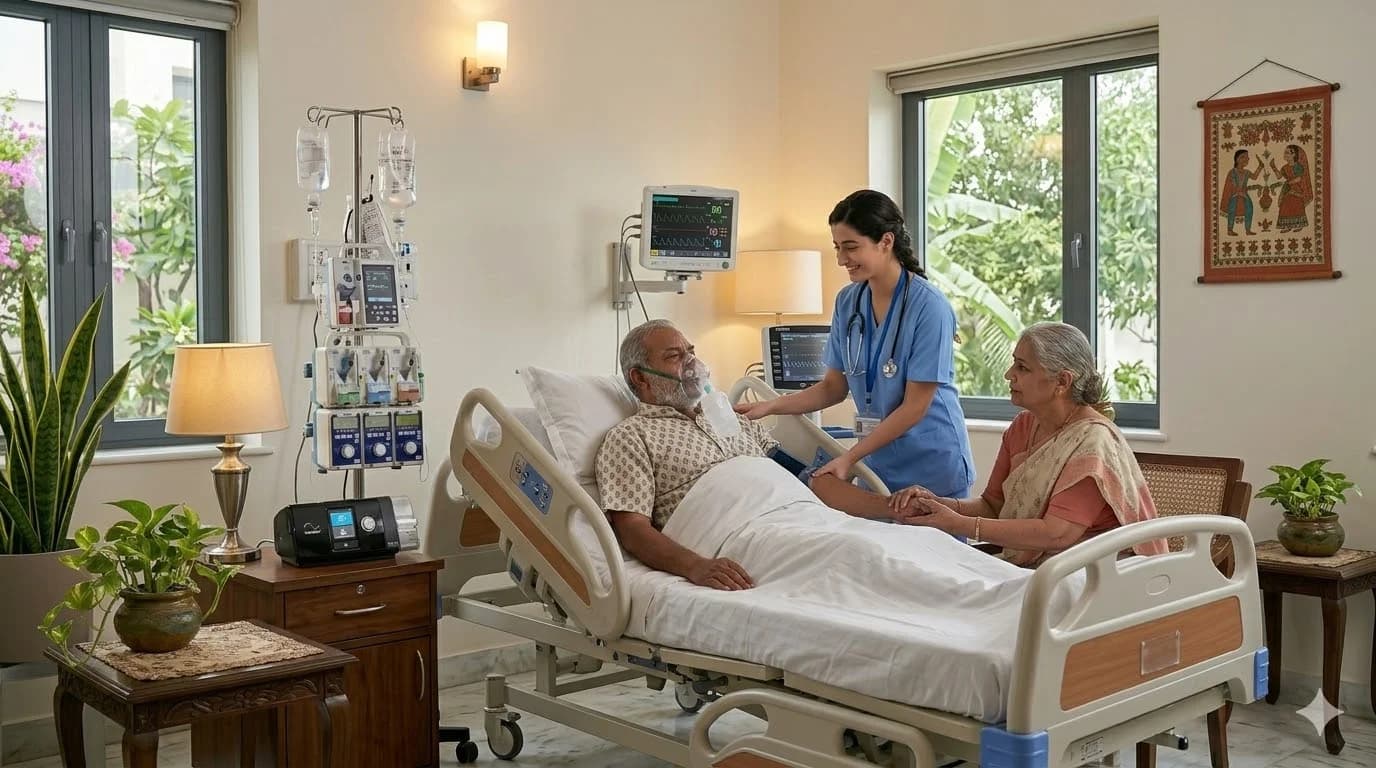
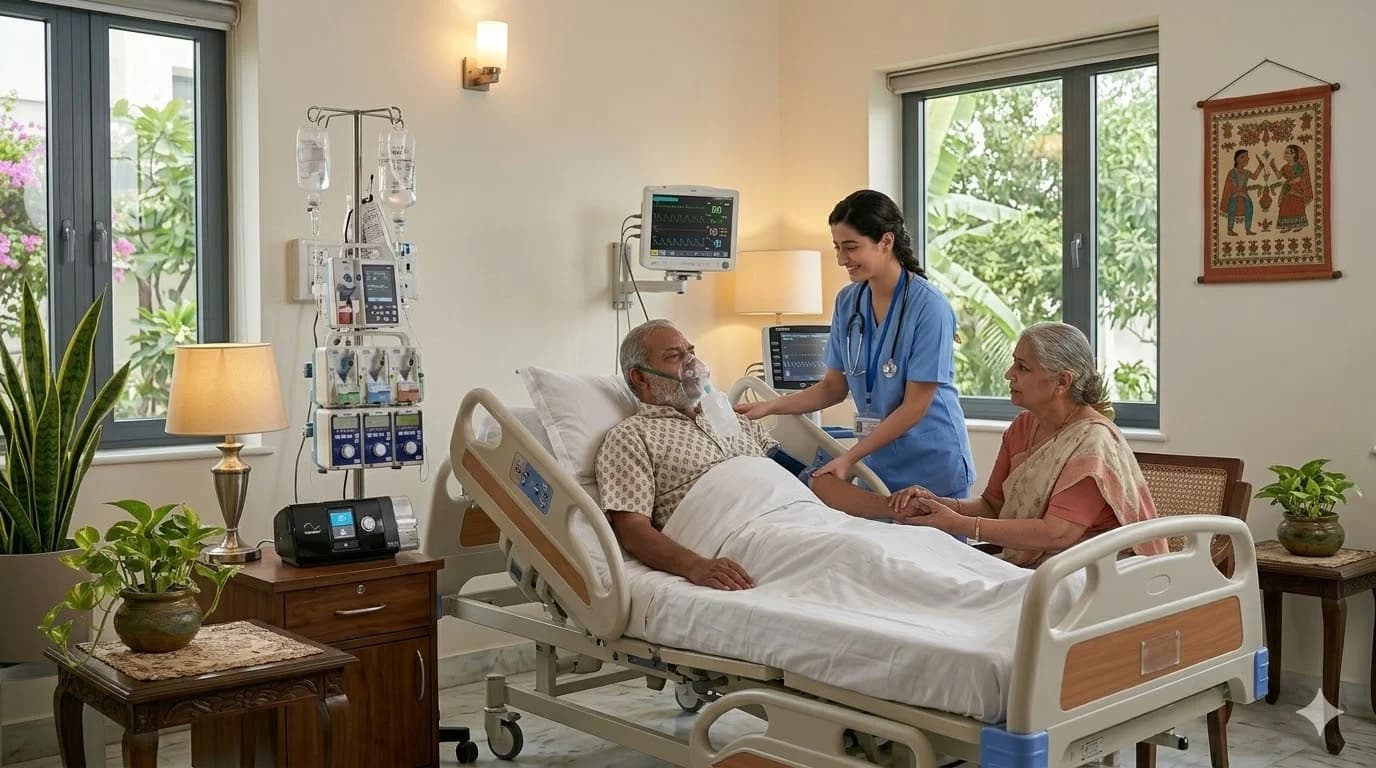
For many patients, the words "you need an IV" used to mean one thing: a hospital stay. That is no longer always the case. A growing number of Indian families are completing prescribed infusion courses at home — receiving antibiotics, hydration, iron, and other therapies in familiar surroundings, under the care of a trained nurse, without an extended inpatient admission.
Done correctly, with a valid prescription, a qualified nurse, and the right safety protocols, home IV infusion therapy can be genuinely beneficial: it reduces exposure to hospital-acquired infections, allows patients to rest in their own environment, and can lower the overall cost of treatment. Done without proper oversight, it carries real risks. This guide explains how the process works, what common home infusions involve, who is appropriate for this model of care, and — most importantly — what it takes to do it safely.
What Home IV Infusion Therapy Is (and Is Not)
An intravenous infusion delivers fluid, medication, or nutritional support directly into the bloodstream through a vein, typically via a cannula inserted in the arm or hand, or through an established central or peripherally inserted central catheter (PICC line) placed by a hospital team.
Home IV infusion is not a shortcut around hospital care, and it is not an over-the-counter service. Every infusion administered at home must be:
- Prescribed by a registered medical practitioner, with a written order specifying the drug, concentration, dose, infusion rate, duration, and frequency
- Administered by a trained nurse with experience in IV therapy, cannula care, and monitoring for adverse reactions
- Supervised by a treating doctor who remains reachable and who has a clear escalation pathway in place if the patient's condition changes
If any of these elements are missing, the risk profile changes significantly. The safety of home infusion rests on the same clinical disciplines as hospital infusion — the setting is different, not the standard.
Our IV infusion support at home is structured around exactly this framework, with nurses working from a physician-issued care plan and coordinators available to escalate when needed.
Common Infusions Administered at Home
Several types of IV therapy are routinely and safely completed in a home setting when appropriate conditions are met.
Intravenous Antibiotics
One of the most common reasons for home infusion in India is completing a course of intravenous antibiotics that began during a hospital stay. Certain infections — osteomyelitis, some deep soft-tissue infections, post-surgical infections — require extended antibiotic treatment that would otherwise necessitate a prolonged admission.
When the patient is clinically stable, afebrile, and tolerating treatment well, many physicians are now comfortable transitioning to home-based administration for the remaining course. The antibiotic must be prepared under appropriate conditions, stored correctly, and administered at the rate and duration specified. Even "routine" antibiotics can cause reactions — anaphylaxis to penicillin-class drugs, for example, is well documented — so a nurse must be present throughout.
Hydration Therapy
Patients who are dehydrated but not acutely unwell — following illness, chemotherapy side effects, or post-surgical fluid depletion — are sometimes prescribed IV saline or dextrose infusions to restore fluid balance. This is generally lower-risk than drug infusions, but still requires clinical oversight: the rate must match what the doctor has prescribed, and the nurse must watch for signs of fluid overload, particularly in elderly patients or those with cardiac or renal conditions.
IV Iron Infusions
Iron deficiency anaemia that has not responded adequately to oral supplementation, or where oral iron is not tolerated, may be treated with intravenous iron. Several iron formulations are now used in India, and while they are generally well tolerated, they do carry a risk of infusion reactions — ranging from mild flushing and joint discomfort to, rarely, more serious hypersensitivity responses.
For this reason, IV iron infusions typically require a test dose, a period of close observation, and a nurse who knows precisely what to watch for and how to respond. The infusion rate prescribed by the doctor must be strictly followed. This is not a therapy to rush.
Other Prescribed Infusions
Patients receiving certain chemotherapy-support drugs, immunological therapies, nutritional support, or bisphosphonates for bone health may also be candidates for home administration, depending on their specific drug, their clinical stability, and their doctor's assessment. Each case is different, and eligibility is always determined by the treating physician.
How a Home Infusion Visit Works
Understanding what to expect helps families prepare and helps everyone — patient, family, and nurse — stay calm and observant.
Before the Visit
The nurse should arrive with the physician's written order in hand, or have it clearly accessible. Any medications to be infused should be obtained from a licensed pharmacy and stored correctly (some IV antibiotics require refrigeration; check with your pharmacist). The nurse will confirm the drug, dose, expiry date, and patient identity before preparing anything.
The patient should be resting comfortably, with a clear working space and good lighting. Inform the nurse of any allergies or previous reactions the patient has experienced, even if this information is already in the care record — repetition here is not redundant, it is good practice.
During the Infusion
The nurse will insert or check the cannula, prime the infusion line, and begin the drip at a slow initial rate before titrating to the prescribed rate. The patient should remain at rest throughout. Family members are welcome to be present; in fact, it is advisable that at least one adult is in the room or nearby.
The nurse will monitor the patient's vital signs and observe for any early signs of reaction. These include:
- Redness, swelling, or pain at the infusion site (possible extravasation or phlebitis)
- Skin flushing, hives, or itching (possible allergic response)
- Shortness of breath, chest tightness, or dizziness (potentially serious — infusion stops immediately)
- Fever or chills during the infusion
If anything appears abnormal, the nurse stops the infusion and contacts the supervising physician. This is why the doctor's emergency contact must be confirmed before therapy begins.
After the Infusion
The cannula may be capped and left in place if further infusions are scheduled within a short period, or removed and dressed at the nurse's discretion and per the care plan. The nurse will document the infusion in the care record and report to the supervising coordinator or doctor.
Who Is Appropriate for Home IV Therapy
Home infusion is not suitable for everyone, and the treating physician's clinical judgment is the only authoritative guide. Broadly, patients who are more appropriate for this setting tend to share certain characteristics:
- They are clinically stable and their vital signs are within acceptable limits
- The infusion is for a drug they have tolerated before, or for a lower-risk agent with a documented test dose protocol
- Their home environment is safe, accessible, and has a responsible adult present
- The treating doctor is accessible and willing to be the point of escalation
- There is a clear, agreed plan for what happens if the patient deteriorates
Patients who are acutely unwell, who have had serious infusion reactions in the past, or who require continuous monitoring between infusions are generally better served in an inpatient setting. The goal is to match the care environment to the patient's actual clinical needs — not to reduce cost at the expense of safety.
Cost Drivers in India
Home IV infusion costs vary significantly, and it is worth understanding what drives those variations so that you can ask the right questions when obtaining a quote.
The primary variables are:
- The drug itself — some IV antibiotics are generic and inexpensive; others are branded or in limited supply and carry significant cost. The drug is often purchased separately from the nursing visit.
- Nursing visit duration — a 30-minute saline infusion and a three-hour antibiotic drip attract different rates.
- Visit frequency — twice-daily antibiotic regimens involve two nurse visits per day; this compounds quickly over a ten-day course.
- Ancillary consumables — IV cannulas, infusion sets, gloves, dressings, and syringes may be included or charged separately; ask upfront.
- City and provider — rates in metros tend to be higher than in smaller cities, and structured agencies with trained nurses and coordination support charge a premium over informal arrangements that reflects the quality of oversight they provide.
As a rough and hedged indication — these are not fixed prices and will vary by city, drug, and provider — nursing visit fees in Indian metros for straightforward infusions might range from a few hundred to over a thousand rupees per visit, with drug costs entirely separate. Complex or long-duration infusions will cost more. Asking for an itemised quote, rather than a bundled daily rate, is always worthwhile.
How to Approach This Safely as a Family
The families who have the best experiences with home IV therapy are those who treat it with the same seriousness they would give to any hospital procedure. A few practical principles:
Start with your doctor. Home infusion is not something to arrange independently and then inform your doctor about. It begins with a clinical decision that the infusion is appropriate for home administration, and a written order that specifies exactly what, how, and at what rate.
Use a structured, accountable service. An agency that employs trained nurses, verifies credentials, provides care coordination, and has a clinical escalation pathway is meaningfully different from an informal arrangement. The premium, if any, buys you accountability and backup.
Stay present. A family member should be in the home throughout the infusion — not hovering anxiously, but present and reachable. Know where the doctor's number is. Know which hospital you would go to in an emergency.
Maintain the cannula correctly. If the cannula is being left in place between visits, follow the nurse's instructions for site observation: redness, swelling, or pain at the site should be reported immediately.
Do not skip doses or extend courses independently. If the infusion is for an antibiotic, completing the full prescribed course is important — stopping early because the patient seems better can contribute to antibiotic resistance and incomplete treatment. Changes to the regimen should come from the treating doctor.
For families considering this option, reading about choosing a home nurse may also be useful — the same principles around qualification verification and clinical oversight apply whether the nurse is providing general nursing care or administering IV therapy.
A Note on Verification
Before any home infusion begins, take a moment to confirm three things: that the nurse can demonstrate relevant qualification and registration, that the infusion order is in writing and matches what is being prepared, and that you have a working phone number for the supervising physician. These three checks take under five minutes and provide meaningful protection.
IV infusion therapy at home is a valuable clinical option when the conditions are right. The conditions — prescription, trained nurse, clinical oversight, clear escalation plan — are not bureaucratic inconveniences. They are the mechanism by which what is done in a hospital safely can also be done, for appropriate patients, in a home.