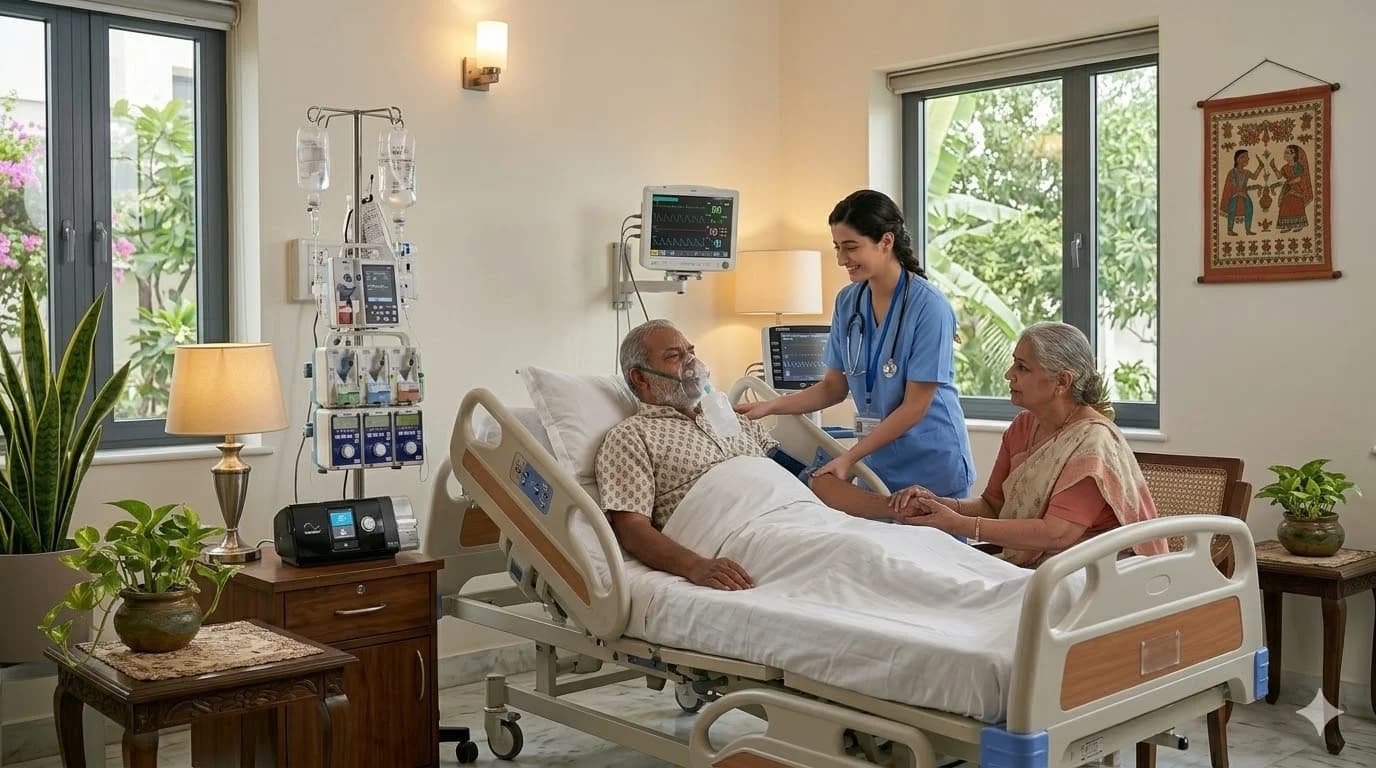
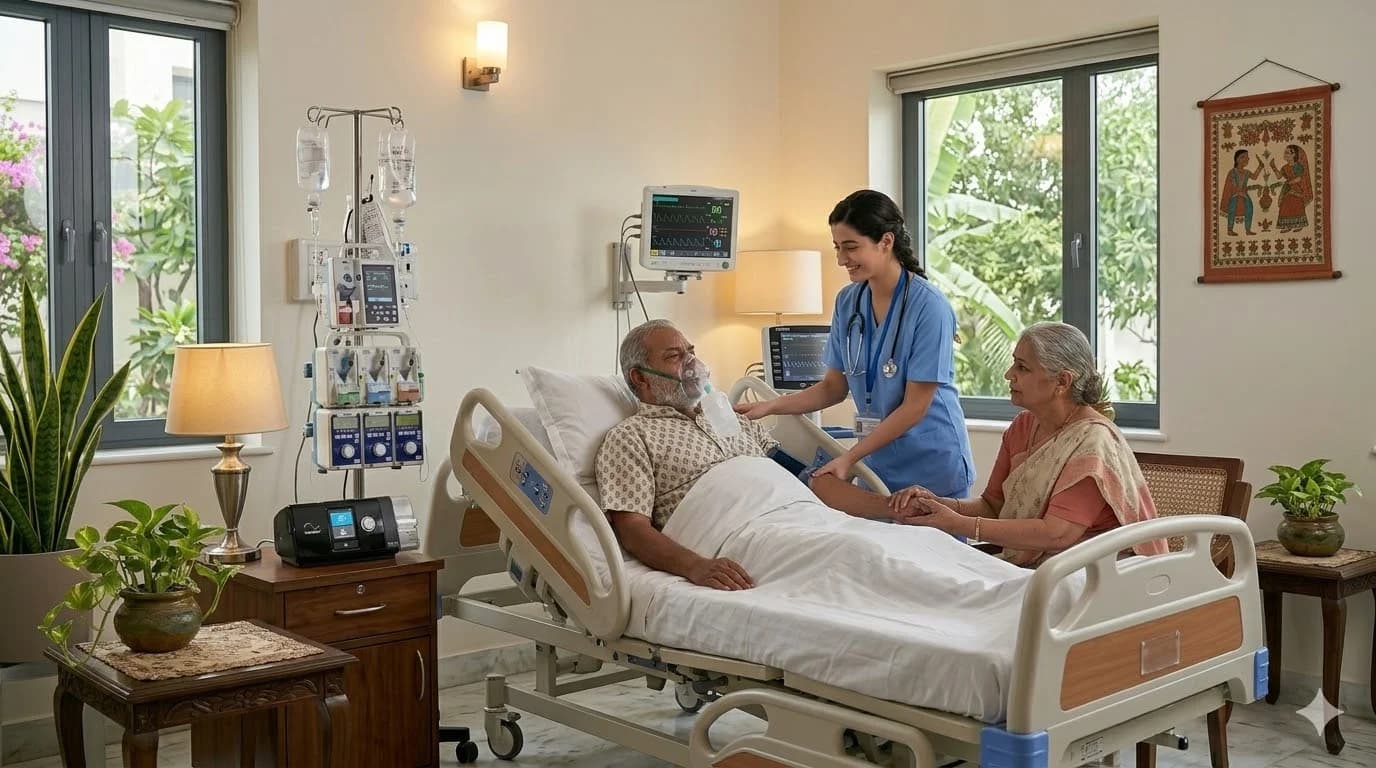
When a family member is discharged from a hospital ICU but is not yet well enough to return to normal home routines, families are sometimes offered a choice that was uncommon a decade ago: continuing a level of monitored care at home rather than extending the hospital stay. Informally called "ICU at home" or "home ICU," this model has grown significantly across Indian cities, and it prompts understandable questions. What exactly does it involve? Is it genuinely safe? And what should families expect to pay?
This guide answers those questions carefully and honestly, because the answers matter enormously for patient outcomes.
What Home ICU Care Actually Means
The phrase "ICU at home" is used loosely in the industry, and that looseness can be misleading. A hospital intensive care unit is a tightly controlled environment: round-the-clock physician coverage, immediate access to a crash team, on-site laboratory and imaging, and a full complement of life-support technology. A home environment, however well-equipped, cannot replicate that.
What reputable ICU at home services actually provide is a structured, clinically supervised step-down of care — support that bridges the gap between hospital discharge and genuine independence. This typically includes:
- A hospital-grade adjustable bed positioned to support patient comfort and reduce risk of complications such as pressure sores
- Monitoring equipment — pulse oximeter, automated blood pressure cuff, and in some cases a cardiac monitor — for tracking key vitals and detecting early changes
- Oxygen support, where prescribed, including an oxygen concentrator or cylinder supply with appropriate flow settings
- Suction equipment for patients who require help clearing secretions from the airway
- Trained nursing on shift rotations, often 12-hour or 24-hour cover, with nurses who have documented critical-care experience
- A physician-linked care plan — a written protocol setting out monitoring frequencies, medication schedules, target vital sign ranges, and specific escalation triggers
- A clear pathway back to hospital if the patient's condition deteriorates
The quality of that last element — the escalation plan — is one of the most important things to assess before agreeing to any home ICU arrangement. A well-designed plan specifies which vital sign values or clinical changes should trigger a call to the doctor, and which should trigger an ambulance. Vague assurances about "24/7 support" are not a substitute for a written protocol reviewed by the treating physician.
When Home ICU Care Is Appropriate
Not every patient who has spent time in a hospital ICU is a candidate for home-based step-down care. The following conditions generally indicate that a transition may be appropriate, subject to full clinical assessment:
- The patient no longer requires invasive mechanical ventilation via an endotracheal tube (patients on non-invasive ventilation such as BiPAP may be candidates if other criteria are met)
- The patient no longer requires vasopressors or continuous intravenous haemodynamic support to maintain blood pressure
- Vital signs are stable and have been so for a period the treating team is satisfied with
- The underlying reason for ICU admission — whether a cardiac event, respiratory failure, post-surgical complication, or sepsis — has been addressed and is being managed on an outpatient or step-down basis
- The patient's home environment is genuinely suitable: a ground-floor or lift-accessible room of adequate size, reliable power supply, and family members who have been briefed on their role in the care plan
The decision to transition must involve the hospital's treating physician or intensivist. This is not something a family should decide in isolation, nor should a home care agency be the primary driver of the recommendation. If an agency is enthusiastic about getting a patient home before the medical team has formally agreed, that is a reason for caution.
When Home ICU Care Is NOT Appropriate
Being clear about contraindications is just as important as describing benefits. Home ICU care should not be considered where:
- The patient remains on invasive ventilator support and cannot safely be weaned, even temporarily
- The patient requires continuous titration of vasoactive drugs to maintain adequate circulation
- The diagnosis is uncertain or the patient's trajectory is unstable and unpredictable
- The home environment cannot safely accommodate the necessary equipment — for example, a very small flat without lift access, or a home with inadequate power reliability for oxygen concentrators
- Family members are not in a position to support the care arrangement — this is not a commentary on family commitment, but a practical reality: a clinical team at home still needs engaged family participation to work safely
- The patient would benefit more from a step-down facility such as a high-dependency unit, which sits between ICU and general ward and provides a level of institutional oversight that a home environment cannot
If a patient is discharged from an ICU prematurely — whether due to bed pressure or premature clinical confidence — and attempts are made to compensate with aggressive home ICU arrangements, the risk profile changes substantially. Families sometimes feel pressure to agree to early discharge. If you have doubts, it is always appropriate to ask the treating team to document in writing that the patient is medically stable for transition.
Equipment, Nursing, and Physician Oversight
A home ICU arrangement has three interdependent components, and weakness in any one of them undermines the others.
Equipment
The equipment needed varies significantly by case. At minimum, most post-ICU patients benefit from a reliable pulse oximeter and an automated blood pressure monitor. Patients with respiratory compromise will need an oxygen concentrator or cylinder arrangement, with flow rates prescribed in writing. Patients at risk of aspiration require a suction machine. Patients who are fully immobile need a pressure-relieving mattress.
All equipment should be sourced from a provider who also supplies consumables (tubing, masks, catheter bags) and who has a defined process for replacing faulty or depleted equipment quickly. In a home ICU context, equipment failure is not merely inconvenient — it can be dangerous.
Nursing
The nurses assigned to a home ICU case should have verifiable critical-care experience. An agency should be able to share the nursing team's credentials, and specifically their experience with ventilator-dependent or high-dependency patients if that is relevant to the case. Shift lengths, handover procedures, and what happens if a nurse is unwell should all be clarified before care begins.
This is an area where choosing a home nurse with the right background makes a material difference to patient safety. General-duty nurses with limited ICU exposure are not well-positioned to manage a patient who has recently been on a ventilator.
Physician Oversight
Home ICU care without active physician oversight is high-risk nursing care, not home ICU care. The treating physician or a designated clinician should review the patient regularly — whether in person, via teleconsultation, or both — and should be reachable if the nursing team identifies a concern outside of scheduled reviews. The care plan should carry the physician's name, contact details, and specific instructions for the nursing team.
Cost Drivers: What Families Should Understand
The cost of home ICU care in India is highly variable, and it is not always easy to compare quotes because providers structure them differently. Several factors drive the cost:
Nursing intensity is typically the largest component. Round-the-clock nursing with two 12-hour shifts requires at least two nurses, and if the case requires ICU-trained nurses specifically, the rate per shift is higher than for general-duty nursing.
Equipment requirements affect cost both through rental fees and through ongoing consumables. An oxygen concentrator rental is one cost; the consumables (mask, tubing, humidifier water) add to it over time.
Case complexity and duration matter significantly. A patient who requires monitoring and oral medication management is a different proposition from one on BiPAP, with a feeding tube, and requiring wound care.
City and provider also affect pricing. Metro cities generally carry higher rates. Agencies that employ verified, credentialed staff and maintain physician coordination as a genuine service (rather than a nominal one) typically charge more than those that do not — and the difference is usually worth understanding before choosing on price alone.
We deliberately avoid publishing specific INR rates here because they change, vary widely by case, and a number quoted out of context can be more misleading than helpful. What we would encourage any family to do is request a written, itemised quote that separates nursing costs, equipment rental, consumables, and any coordination or oversight fees. Ask specifically what is included in the rate and what is billed additionally. A transparent provider will give a clear answer.
Questions to Ask Before Committing
Before agreeing to a home ICU arrangement, these questions are worth putting in writing to the provider:
- Has the treating physician formally approved the home ICU transition, and can I see documentation?
- What are the specific escalation criteria in the care plan — which vital sign values trigger a call to the doctor, and which trigger an ambulance?
- What are the nursing qualifications of the team assigned to this case, and what specific ICU experience do they have?
- What equipment is included, and what is the process for equipment failure or replacement?
- How often will a physician or clinical supervisor review the patient, and how?
- What happens if the patient's condition deteriorates at 3 a.m. — what is the exact process?
A provider who cannot answer these questions clearly and in writing is not a provider you want managing a high-dependency patient at home.
What ElivioCare Does Differently
ElivioCare's home ICU service is built around the principle that physician oversight and nursing quality are not optional extras — they are the foundation. Our clinical coordinators work with the treating hospital team before the patient is discharged, review the care plan before the first nursing shift begins, and remain available as a point of contact throughout the care arrangement.
We do not recommend home ICU care for patients who are not clinically ready for it. If a family contacts us and the clinical picture suggests the patient should remain in a step-down facility rather than moving home, we say so.
If you are considering home ICU care for a family member, the most important first step is a conversation with the treating team about readiness — not a conversation about equipment or cost. Once the clinical picture is clear, everything else follows from there.