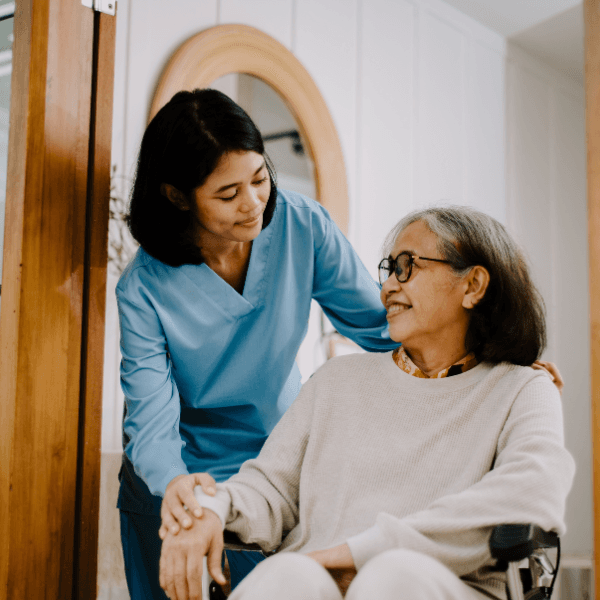

Choosing how to care for an aging parent is one of the most consequential decisions a family will make. It touches money, relationships, safety, and — perhaps most importantly — the elder's own sense of home and identity. The options broadly split into two categories: keeping the person at home with professional support, or transitioning them to a residential old-age or assisted-living facility. Neither is universally right. Each carries real benefits and real limitations, and the honest answer usually depends on factors that are specific to one family.
This article sets out the key dimensions of the comparison — cost, safety, dignity, social connection, and clinical complexity — so that you can think through the decision systematically rather than under pressure.
Understanding the Core Difference
Before comparing the two, it is worth being precise about what each option actually means in practice.
Elder care at home means the person continues to live in their own home (or a family member's home) and receives care through a combination of family involvement, hired caregivers, and visiting professionals such as physiotherapists or home-visit doctors. The degree of professional involvement can range from a few hours of daytime assistance each week to a round-the-clock live-in caregiver arrangement.
Old-age homes and assisted-living facilities range from basic residential homes offering shared accommodation and meals, to full-service assisted-living communities with on-site nursing staff, recreational programmes, physiotherapy, and memory-care units. The quality and cost vary enormously across India.
Understanding which of these matches your parent's actual needs — not an idealised version, but their day-to-day reality — is the first step.
Our elder care at home service is built around exactly this kind of needs assessment: a clinical coordinator reviews the elder's medical situation, living environment, and family capacity before recommending a care plan.
Comparing Costs
Cost is often the deciding factor, yet it is also the area where families most commonly make mistakes — either by comparing only the headline monthly fees or by failing to account for what happens when care needs intensify.
Home-Based Care: What to Expect
Indicative monthly costs for home-based elder care in India (these are broad guides, not guarantees — actual rates depend heavily on city, case complexity, and provider):
- Part-time daytime caregiver (4–6 hours/day): roughly ₹12,000–₹25,000 per month in major metros
- Full-time single-shift caregiver (8–10 hours/day): roughly ₹20,000–₹40,000 per month
- 24-hour live-in caregiver: roughly ₹35,000–₹70,000 per month or more, depending on medical training required
- Add-ons: home physiotherapy sessions, doctor home visits, consumables (gloves, dressings), and equipment rental (wheelchairs, hospital beds) are usually billed separately
Home-based care also preserves existing household costs — rent, utilities, domestic staff — which are not eliminated when a caregiver is added. For families already managing a household, the marginal cost is the caregiver; for families who maintain a separate property for the elder, costs add up quickly.
Residential Facilities: What to Expect
- Basic old-age home (shared room, meals included): roughly ₹8,000–₹18,000 per month
- Mid-range assisted living (private or semi-private room, some nursing support): roughly ₹25,000–₹60,000 per month
- Premium assisted living or memory-care unit: roughly ₹60,000–₹1,20,000 per month or more
These fees typically bundle accommodation, meals, basic nursing supervision, and activities. However, higher-acuity care — hospitalisations, specialist visits, personal medications — is usually billed on top.
The Hidden Costs on Both Sides
Home care can be underpriced in the mind if families do not account for family members reducing their working hours to coordinate care. Residential facilities can be overpriced in the mind if families assume the headline fee covers everything. Before making a financial comparison, ask both options to itemise what is and is not included.
Safety and Medical Supervision
Where Home Care Has the Edge
For elders with stable, manageable conditions, home care offers a clinically familiar environment. Medication schedules can be closely monitored by family. Falls-prevention adaptations — grab bars, removal of loose rugs, better lighting — can be made to a space the elder already knows. A dedicated caregiver who sees the same person every day often notices early warning signs — a change in appetite, unusual confusion, skin changes — that might be missed in a busier facility with higher staff-to-resident ratios.
Where Facilities Have the Edge
For elders who require frequent clinical intervention — regular IV therapy, intensive wound care, ventilator management, or round-the-clock observation following a serious fall or stroke — a well-equipped facility with on-site nursing and rapid access to emergency care may genuinely offer better safety outcomes than home care can. Families should be honest about whether their home environment and available caregiver skill are a realistic match for the clinical complexity involved.
Falls are the most common serious risk in elder care. Both settings must address this, but a purpose-built facility will typically have fewer environmental hazards and call-bell systems throughout. A home can be adapted, but extensive adaptation has a cost.
Dignity, Identity, and Emotional Wellbeing
This is the dimension that families sometimes feel uncomfortable quantifying, but it is not trivial.
Most elders — when asked — prefer to remain at home. Familiarity with their own space, proximity to lifelong possessions, independence in daily routines, and the presence of family members all contribute meaningfully to psychological wellbeing. For people living with dementia, the disorientation caused by moving to an unfamiliar environment can accelerate cognitive decline.
At the same time, isolation at home — particularly when a frail elder spends long hours without stimulation or social contact — is its own risk. Depression, reduced mobility, and cognitive decline can all worsen when an elder is effectively housebound with minimal interaction. A good residential community, with structured activities, peer relationships, and engaged staff, can offer richer social life than many home environments.
Neither option is inherently more dignified. What matters is whether the specific arrangement — home or facility — is genuinely attentive to the elder's preferences, routines, and relationships.
When Home Care is Usually the Right Starting Point
Consider home-based elder care at home when:
- The elder has a strong, clearly expressed preference to remain at home
- The medical conditions are manageable with trained caregiver support and periodic professional visits
- Family members are able to be reasonably involved in coordinating care, even if they are not providing hands-on care themselves
- The home environment can be made reasonably safe with adaptations
- The elder has meaningful relationships and activities in the community that would be disrupted by relocation
For a detailed look at how professional support is structured for home-based care, our companion article on choosing a home nurse walks through the qualification and selection process.
When a Residential Facility Deserves Serious Consideration
Consider transitioning to a residential facility when:
- Care needs have become too intensive or unpredictable to be safely managed at home, even with professional support
- The elder is significantly isolated and would genuinely benefit from a structured social environment
- The family's capacity to coordinate home care has been exhausted — caregiver burnout is a real and serious concern
- The elder's living environment cannot be adequately adapted for their physical needs
- The elder themselves expresses a preference for community living or feels they are becoming a burden to family
Many families resist this conversation longer than they should, often at cost to their own health. A good residential facility is not an abandonment of the elder — it is a different model of care, and for some elders in some circumstances, it is the model that best meets their needs.
How to Make the Decision: A Practical Framework
Rather than treating this as a one-time binary choice, think of it as a staged assessment:
- Start with the elder's expressed preferences. Where possible, have the conversation directly with the person concerned — not around them.
- Get a clinical assessment. A geriatrician or your parent's primary physician can provide an objective view of what level of care is clinically indicated.
- Map the realistic home support available. Not what you hope to provide, but what you can sustainably provide — including professional care and family involvement — over six to twelve months.
- Visit facilities before a crisis forces the decision. Touring two or three local facilities while there is no immediate pressure is very different from making a rushed placement after a hospitalisation.
- Plan for escalation. Whatever you choose now, build in a review point — six months out — where you assess whether the arrangement is still working for everyone.
The goal is not to find a permanent answer but a right-now answer, with the flexibility to adapt as circumstances change.
A Note on Hybrid Approaches
Home care and residential care are not always mutually exclusive. Day-care programmes attached to residential facilities allow elders to spend weekday hours in a structured, socially active environment and return home each evening. Respite care placements — where an elder spends two to four weeks in a facility while the family takes a break — can relieve caregiver burnout without a permanent transition. These middle-ground options are increasingly available in larger Indian cities and are worth exploring before treating the choice as all-or-nothing.
Getting Started
If you are in the early stages of this conversation, the most useful next step is usually a frank assessment of where the elder's care needs currently sit and how quickly they are likely to intensify. From that baseline, both home care and residential options become easier to evaluate against your family's specific circumstances.
Whatever path you choose, prioritise finding support from people — caregivers, coordinators, or facility staff — who treat your parent as an individual with preferences and a history, not simply as a patient to be managed.