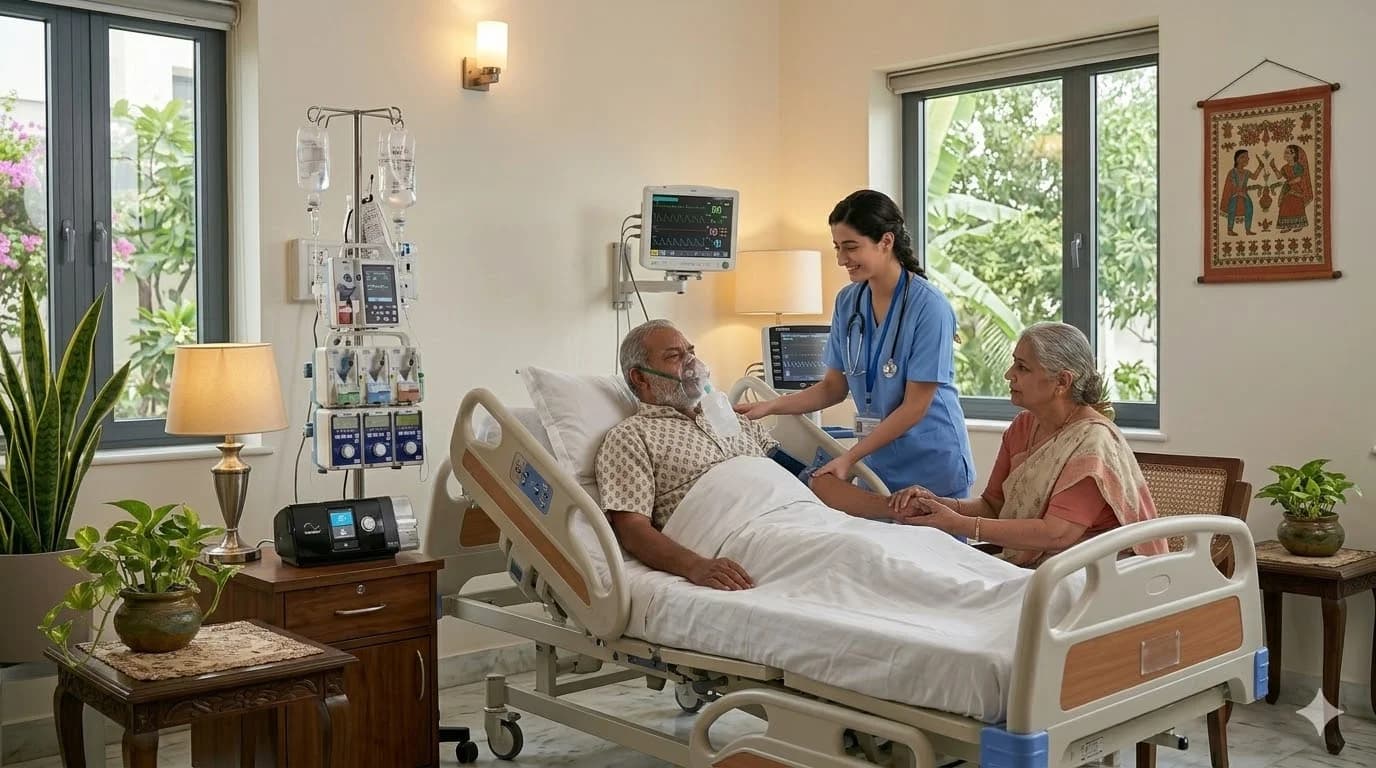
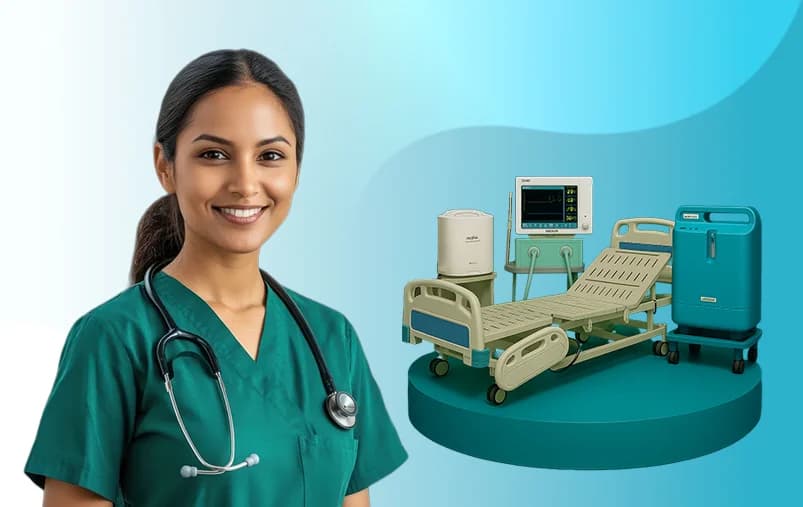
When a family member comes home from hospital after a major surgery or a long ICU stay, the ward round of equipment that supported their recovery — the adjustable bed, the oxygen concentrator, the suction unit — does not come home with them. Families are left to source it themselves, often within 24 hours and under significant stress. This guide is intended to make that process less overwhelming.
What Equipment Does a Home-Care Patient Typically Need?
Not every patient needs every category of device, but these are the most commonly requested items for home nursing and post-hospital recovery:
Hospital Beds and Pressure Mattresses
A standard domestic bed is not suitable for a bedridden or partially mobile patient. Hospital-grade beds offer:
- Side rails — to prevent falls and give the patient a grip point for repositioning
- Adjustable head and foot sections — critical for patients with respiratory conditions, post-abdominal surgery, or oedema
- Height adjustment — enables safe transfer and reduces carer injury risk
- Anti-decubitus (pressure-relief) mattresses — alternating-air or foam overlays that are non-negotiable for any patient who will spend more than a few days in bed
If your family member is returning home after a hip replacement, abdominal surgery, or a stroke, a proper hospital bed is not a luxury — it is a direct patient safety requirement.
Oxygen Concentrators
Oxygen concentrators extract oxygen from ambient air and deliver it at controlled flow rates (measured in litres per minute, or LPM). They are used for patients with COPD, post-COVID respiratory impairment, congestive heart failure, and recovery from pneumonia or major thoracic surgery.
Key parameters to check before sourcing:
- Prescribed flow rate — match the concentrator's maximum output to what the treating physician has specified
- Continuous vs. pulse-dose — most home-use patients are on continuous flow; pulse-dose devices are not suitable for all clinical indications
- Power consumption and backup — concentrators draw significant power; ask the supplier about inverter or UPS compatibility if your locality has load-shedding
Wheelchairs
Wheelchairs divide into two broad categories for home use:
- Manual wheelchairs — standard, attendant-propelled, or self-propelling; suitable for patients with sufficient upper-body strength
- Reclining or tilt-in-space wheelchairs — for patients with limited trunk control, spasticity, or extended sitting time
Measure doorway widths in your home before selecting a model. Standard Indian urban apartments often have internal doors as narrow as 28–30 inches, which rules out wider bariatric chairs.
Suction Machines
Portable suction machines are essential for patients with impaired swallowing, tracheostomy tubes, or excessive secretions. They are also used post-surgically when surgical drains are in place. Ensure that the nurse managing the patient at home is trained in safe suctioning technique — the equipment alone is not sufficient without the clinical skill to use it correctly.
Our medical equipment rental service covers all of these categories and includes delivery, installation, and nursing orientation so that the patient's care team knows how to use each device safely.
Rent vs. Buy: How to Decide
This is the question most families ask first, and the answer depends on four variables: duration of need, patient prognosis, storage and maintenance capacity, and budget flexibility.
When Renting Is the Right Choice
- Short or uncertain duration — post-surgical recovery periods are often measured in weeks, not months. Buying a ₹30,000–₹60,000 hospital bed for a six-week recovery rarely makes financial sense.
- Trial before committing — some patients discover that a particular piece of equipment is not well-suited to their home layout, their condition, or their carer's capability. Renting first removes the risk of an expensive, hard-to-resell purchase.
- Equipment servicing and maintenance — reputable rental suppliers include periodic servicing, consumable replacements (e.g., oxygen tubing, suction catheters), and breakdown support. Owners bear these costs entirely themselves.
- Storage after use — a hospital bed occupies a significant footprint. Returning rented equipment to the supplier after recovery is far simpler than storing or selling a purchased unit.
When Buying May Be Justified
- Long-term or permanent need — patients with progressive neurological conditions, permanent paralysis, or end-stage chronic disease will need equipment for years. In these cases, the cumulative rental cost will typically exceed purchase cost within six to twelve months.
- Very specific clinical requirements — if a patient needs a configuration that is rarely stocked by rental suppliers — for example, a bariatric bed with a specific mattress system — purchasing may be the only practical option.
- Family ownership preference — some families prefer ownership for reasons of hygiene assurance or emotional comfort. If this is the case, ensure the equipment comes with a manufacturer's warranty and that a local technician is available for servicing.
As a rough illustration — and these are indicative, not precise figures — a standard hospital bed might be available to rent for somewhere in the range of ₹1,500–₹4,000 per month, whereas purchase prices for equivalent models typically start at ₹20,000–₹40,000 and climb substantially for electric or ICU-grade variants. At those rental rates, the break-even point is often eight to eighteen months, after which owned equipment begins to cost less over a long horizon. These figures vary widely by city and supplier; always obtain a written quotation.
Sizing, Setup, and Safety
Getting the equipment into the home correctly is as important as selecting the right equipment.
Before Delivery
- Measure the room — confirm there is enough floor space for a full hospital bed with clearance on both sides (nurses need access from either side to perform wound care and personal hygiene)
- Check doorway widths for the delivery route — some hospital beds require partial disassembly to pass through standard internal doors
- Identify a power point for electrically powered equipment (oxygen concentrators, electric beds, suction machines) — extension cords are a tripping hazard and should be avoided or managed carefully
During Setup
Insist on a demonstration from the delivery technician. For oxygen concentrators specifically:
- Confirm the alarm function works before the technician leaves
- Understand what to do in a power failure (backup cylinder, transfer to hospital)
- Keep the unit at least 15 cm from walls to allow adequate air intake
For beds: verify that the side rails lock securely and that the mattress overlay (if supplied) is correctly installed with no pressure-point gaps at the head or foot.
Ongoing Safety Checks
- Oxygen concentrators should have their filters cleaned every two weeks and their tubing replaced periodically per the manufacturer's schedule
- Suction machines should have their collection bottles checked and emptied after every use; check the suction pressure calibration if performance seems reduced
- Wheelchairs should have tyre pressure checked (for pneumatic tyres) and brakes inspected monthly
Hygiene and Maintenance for Rented Equipment
One of the most frequent concerns families raise about rented medical equipment is hygiene. This is a legitimate concern, and a reputable supplier should be able to answer the following questions before you take delivery:
- What cleaning and disinfection protocol is used between patients? Look for suppliers who follow hospital-grade disinfection procedures using appropriate surface disinfectants, not just a wipe-down.
- Are mattresses covered with medical-grade impermeable covers? Foam mattresses that have been in contact with a previous patient's bodily fluids represent an infection risk if not properly managed.
- Is the equipment visually inspected for damage before reissue? Side-rail integrity, electrical cord condition, and wheel locking mechanisms can degrade with use.
For families who remain concerned, it is entirely reasonable to request that the rental supplier provide you with a sealed replacement mattress cover on delivery, or to purchase a new mattress cover separately. The structural components of the bed itself present minimal infection risk when properly disinfected.
What a Complete Home Care Plan Needs
Equipment alone does not constitute a care plan. For a patient transitioning home from hospital, the equipment is one component of a wider support system that should include:
- A trained home nurse matched to the patient's clinical complexity — as we describe in detail in our guide to choosing a home nurse
- Clear handover documentation from the hospital — discharge summary, medication list, wound care instructions, and any equipment-specific notes from the ward staff
- A single coordination contact who can be reached if the patient's condition changes, if equipment fails, or if the nursing team has a question about clinical management
- A follow-up plan — dates for the next physician review, physiotherapy if needed, and any laboratory tests that should be repeated
Families who try to manage these elements independently — sourcing equipment from one supplier, a nurse from another, and coordinating with the treating hospital themselves — often find the administrative load exhausting at a time when their energy is already depleted by the patient's illness.
ElivioCare's clinical coordinators can help with all of these elements, including matching the equipment requirements to the patient's nursing plan so that nothing falls through the gaps between the bed delivered and the nurse who arrives to care in it.
A Note on Prescription and Clinical Oversight
Some equipment categories — oxygen concentrators in particular — should only be used based on a physician's prescription specifying the flow rate, delivery method, and target oxygen saturation. Using supplemental oxygen without medical supervision can be harmful in certain patient populations, including those with COPD Type II respiratory failure where hypoxia is the primary driver of respiratory effort. Always confirm the prescription parameters with the treating physician before placing a rental order for oxygen equipment.
For equipment that does not carry the same clinical risk — hospital beds, manual wheelchairs, pressure mattresses — no formal prescription is required, but it is still worth ensuring that the choice of equipment aligns with any physiotherapy or occupational therapy recommendations from the hospital discharge team.
Sourcing the right home-care equipment does not need to be a rushed decision made on the day of discharge. If you know a hospital admission is planned — for surgery, for example — begin the equipment assessment a few days in advance. This allows time for a home visit to assess space and layout, for the right equipment to be confirmed as available, and for delivery to be scheduled at a time that suits the family rather than rushed to coincide with the ambulance arriving at the door.